


Post Author:
Blink Juwele
Categories:
Date Posted:
March 20, 2021
Share This:
6 Psychological effects of jewelry
Ever wondered what the 6 Psychological effects of jewelry wearing is? ? Most people love jewelry, but what are the psychological reasons behind the human race’s fascination with wearing jewelry? Would we be any different if we didn’t wear jewelry?
Yes, you look good, and your outfit would look plain without the right kind of jewelry, but which are the main psychological reasons and meaning behind jewelry wearing?
Jewelry has been worn by humans for thousands of years, and for good reason. Not only does jewelry enhance our physical appearance, but it also has a variety of psychological effects that can boost our confidence and well-being. Here are six psychological effects of jewelry:
- Self-expression
Jewelry can be a form of self-expression, allowing us to communicate our personality and values without saying a word. For example, someone who wears bold, statement pieces may be seen as confident and outgoing, while someone who wears simple, understated jewelry may be seen as more reserved.
- Emotional attachment
We often attach sentimental value to jewelry, making it more than just an accessory. A piece of jewelry given to us by a loved one can evoke strong emotions and serve as a reminder of that person and their relationship with us.
- Status symbol
Jewelry has historically been a symbol of wealth and status, and that association still holds true today. Wearing expensive or designer jewelry can signal to others that we are successful and financially secure.
- Cultural significance
Jewelry can also have cultural significance, representing traditions, beliefs, and values of a particular culture. For example, in some cultures, certain types of jewelry are worn to signify a person’s marital status or to ward off evil spirits.
- Mood booster
Wearing jewelry can have a positive effect on our mood and overall well-being. Putting on a favorite piece of jewelry can make us feel more put-together and confident, boosting our self-esteem and reducing anxiety.
- Memory aid
Jewelry can serve as a memory aid, helping us remember important events and milestones in our lives. For example, a piece of jewelry purchased on a special trip or to commemorate a significant accomplishment can serve as a tangible reminder of that experience.
In conclusion, jewelry is much more than just a pretty accessory. It has a variety of psychological effects that can impact our emotions, behavior, and overall well-being. By understanding these effects, we can make more intentional choices about the jewelry we wear and how it can positively impact our lives.



Psychological effects of jewelry
From an anthropological perspective, the use of gems and gold to accessorize is a practice that can be traced back to a Millennia. Specifically to the ancient culture like the Mesopotamian and the Egyptian cultures.
Since then, jewelry has been a part of human civilization that is here to stay.
Over the centuries, adorning the body with jewelry has been very consistent across both time and space. Cutting across cultures, regions, gender, and class.
The Tibetans and the Aztecs ae two of the biggest groups known for the most diverse items of jewelry and their appreciation of jewelry that have stood the test of time and are fashionable to date.
Today, we have diamonds as one of the most coveted items of jewelry. While the jury is still out on the rarity of diamonds and their intrinsic value. It’s remained the mark of superiority where jewelry is involved.
Besides diamonds, there also are paved, elasticized jewelry with tens of the best rhinestones. These are also very desirable as onomatopoeic kind of bling, and they are priced expensive.
These details about jewelry and just how long the human race has adored being adorned in jewelry brings about the important question. Why do we have the need for wearing jewelry?
The next section of this article explores the psychology of jewelry wearing. So, keep reading.
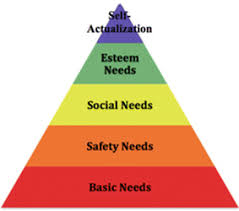 To understand why we have the need to wear and gift each other jewelry, we first need to take a look at the Hierarchy of Needs by Maslow. This pyramid breaks down the human needs into five important ranks. Physiological needs, Safety, Belonging/Love, Esteem, and Self-actualization.
With this pyramid ranking in mind, jewelry falls somewhere between the social and esteem needs. By social needs, we mean the need to belong to a group and other kinds of relationships. While the self-esteem needs have to do with the desire for recognition, and also status.
It is, therefore, apparent that jewelry is a middling need and not an essential physiological need – you cannot compare jewelry with food, water, sex, shelter, or safety. And you also cannot compare it to a lateral need such as self-actualization.
Jewelry is more of an agent of your personality; it’s something we identify with, for example, birthstones. We are very animistic when it comes to jewelry, and this can be seen in how it’s become harder for us not to derive some deep meaning like a soul or personality from jewelry.
The birthstone’s personality, for example, has become a new point of self-identification, which is why amethysts symbolize sobriety, while rubies symbolize passion. With these forms of beliefs associated with these stones, we tend to feel these things when we wear the symbolic stone jewelry.
But this shouldn’t be the case; you shouldn’t be able to define yourself only by a birthstone.
 Then there is the matter of wealth and assertion of status.
From the times of the monarchs, empresses, emperors, and the Pharaohs, expensive, and the best jewelry was associated with wealth and a higher status in society.
This was common at the time, and among these groups, because they had a better standard of living, not having to worry about food and other physiological needs.
As a result, wearing jewelry was the status symbol of success and wealth in society.
But is that why we are drawn to jewelry? There is affordable jewelry today, and everyone is wearing jewelry, which means that status isn’t the only reason why we are wearing jewelry. There must be more to it.
We have an inherent affinity for precious metals and pretty stones, and anthropologists believe that this could be the case because the only reason why something would be coveted universally was if that item possessed an inherent value.
In this case, naturally beautiful pieces of jewelry are used to symbolize nature’s beauty.
But that can’t be all. Perhaps we wear jewelry because we need and are looking for something different/ deeper, something higher – say the knowledge that some of the most aesthetically pleasing things could be easily created independent of human interference and governance.
 At the same time, psychologists and anthropologists cite the need and role of jewelry as the thing that brings together the mating/ dating world. In this school of thought, jewelry must be synonymous with the breathtaking natural splendor of peacocks whose feathers are pretty much colorful jewels.
Since humans lack what the peacocks have, the stones and precious metals help humans look to shine and sparkle.
For instance, earrings will draw attention to your erogenous earlobes, the belly bars will draw attention to your naval, while pedants shine the light on your bosom.
And on the contrarian end, you have the wedding band, which will serve as the barrier to an amorous stranger, warning them that the stranger they are interested in has been spoken for.
If you go with this perspective, we wear jewelry to persuasively imply that it would be crass to communicate some things with words. Therefore, we can see that Jewelry fits in Maslow’s pyramid.
Take the wedding band, for example.
This simple metal is a symbol of the complex concept of the union between two people and the blessing of the union by the Holy Spirit.
Of course, this won’t make sense to everyone, but it’s an expression of love, marriage, eternity, fidelity, and God.
At the end of the day, the need for jewelry is entirely symbolic, hence the polymorphism of symbolism.
Here, what we mean is that jewelry symbolizes different things – sex, birth, marriage, covenants, wealth, martial success, mourning, etc.
Conclusion
Jewelry is an important part of human culture. Besides being aesthetically pleasing and its power to call out human attention, it symbolizes many things that we prefer using symbols to describe – sexual appeal, birth, unavailability, status, etc.
#Blinkies, thanks for reading. For more info on Stainless Steel Jewelry and the 6 Psychological effects of jewelry, please contact us or visit our Facebook page